What You Need To Know
Loose or ill-fitting crib mattresses are a common, fixable hazard. This short safety guide gives exact gap tolerances to aim for, which shim approaches are acceptable (and which to avoid), plus a rapid inspection checklist you can use today.
The Safe Baby: A Do-It-Yourself Guide to Home Safety
The Safe Baby: A Do-It-Yourself Guide to Home Safety stood out for parents who want thorough, hands‑on safety checks and fixes. and balanced scoring across the most useful buying criteria.
View Deal On Amazon
Crib mattress fit safety guide: acceptable gaps, shim use, and inspection checklist
The validated resources below are practical references for crib and nursery safety. The three books provide step-by-step home-safety and nursery setup guidance; the poster is a concise visual reminder of infant sleep rules for a nursery wall. Use a book for detailed procedures and the poster as a quick checklist near the crib.
The Safe Baby: A Do-It-Yourself Guide to Home Safety
Debra Smiley Holtzman
A practical, room-by-room manual for parents who want clear, actionable home-safety steps — good for parents installing and checking nursery fixtures.
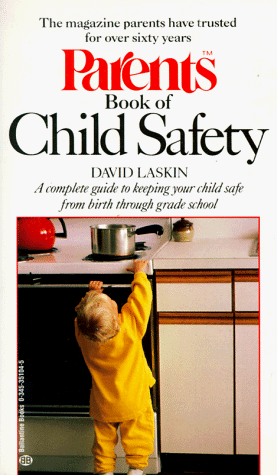
Parents Book of Child Safety
David Laskin
Compact, budget-friendly guide covering general child-safety topics with quick checklists useful for new parents setting up a nursery.

First Home: Mothercare Nursery Guides
Rebecca Williams
Nursery-focused guide with advice on layout, furniture selection and putting together a safe sleep space.

Baby Safe Sleep Guide Poster — Infant Sleep Safety Rules Nursery Wall Art
Unknown
A large wall poster listing key infant sleep safety rules — useful as a constant visual reminder in a nursery.
Buying Notes
Choose a firm crib mattress that matches your crib model and size exactly (standard full/standard crib/full-size). Prefer mattresses sold or recommended by the crib manufacturer. If support is the issue, buy only manufacturer-approved shim kits or a single, rigid noncompressible shim (up to 1/4 inch / 6 mm) cut to fit and permanently fastened; never use soft materials (towels, pillows, foam scraps). Replace mattresses that are compressed, torn, or cannot be fitted to meet the gap limits below.
The Safe Baby: A Do-It-Yourself Guide to Home Safety: pros and cons
Pros
- Room-by-room checklists and DIY fixes
- Practical, accessible language for non-experts
- Covers common nursery hazards beyond mattresses
Cons
- Not crib-mattress–specific (broad home-safety focus)
- Print edition may not have crib model-specific guidance
A practical, room-by-room manual for parents who want clear, actionable home-safety steps — good for parents installing and checking nursery fixtures.
The Safe Baby: A Do-It-Yourself Guide to Home Safety: score breakdown
Parents Book of Child Safety: pros and cons
Pros
- Short, focused chapters
- Low cost
- Good quick-reference checklists
Cons
- Less depth on crib/mattress technicalities
- Older editions may not reflect newest standards
Compact, budget-friendly guide covering general child-safety topics with quick checklists useful for new parents setting up a nursery.
Parents Book of Child Safety: score breakdown
First Home: Mothercare Nursery Guides: pros and cons
Pros
- Nursery-specific planning and setup tips
- Practical crib and mattress sizing guidance
- Easy-to-follow illustrations
Cons
- May be high-level on technical tolerances
- Less emphasis on long-term inspection protocols
Nursery-focused guide with advice on layout, furniture selection and putting together a safe sleep space.
First Home: Mothercare Nursery Guides: score breakdown
Baby Safe Sleep Guide Poster — Infant Sleep Safety Rules Nursery Wall Art: pros and cons
Pros
- High-visibility, constant reminder
- Compact way to convey key sleep rules to caregivers
Cons
- Not a detailed how-to resource
- Poster content quality varies; not crib-specific
A large wall poster listing key infant sleep safety rules — useful as a constant visual reminder in a nursery.
Baby Safe Sleep Guide Poster — Infant Sleep Safety Rules Nursery Wall Art: score breakdown
Frequently Asked Questions
What exact gap is safe between a crib mattress and the crib frame?
Aim for an ideal gap of 0–1/4 inch (0–6 mm). The maximum acceptable gap is 1/2 inch (≈12 mm). If you cannot get the gap under 1/2 inch, stop using that mattress/crib pairing.
How do I measure the gap quickly?
Use a stiff ruler or caliper and measure at the head, middle and foot of the mattress where it meets the side rails. Measure the largest gap; that number controls.
Can I use a towel, blanket, or pillow as a shim?
No. Soft/compressible materials can create entrapment and suffocation hazards. Only use noncompressible, rigid shims or manufacturer-approved shim kits.
When should I replace the crib mattress?
Replace if the mattress has a permanent indentation or sag greater than 1/2 inch (≈12 mm), any rips/exposed filling, broken seams, or if you cannot achieve the gap tolerance (≤1/2 inch).
What if my mattress and crib are different brands or slightly different sizes?
Best practice: use a mattress sized or recommended for that crib. If sizes differ and you cannot meet the 1/2 inch maximum gap even after approved shimming, replace the mattress or crib.